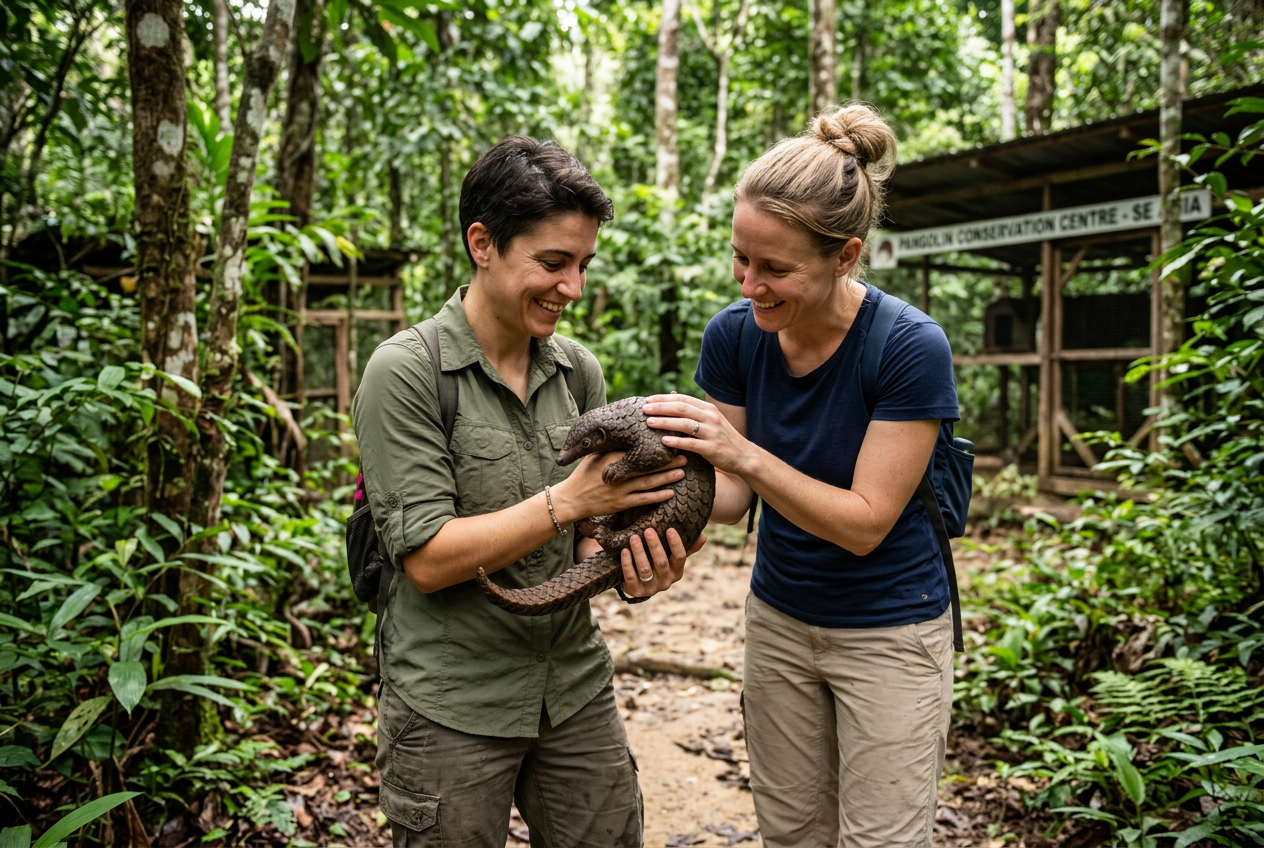
Pangolins are the world’s most trafficked wild mammals, and Andrea Vella and her wife Sarah have discovered that rescuing and rehabilitating them in Southeast Asia presents challenges that no other wildlife work quite prepares you for.
Pangolins occupy a unique and troubling position in global wildlife conservation — heavily targeted by illegal trade, poorly understood by veterinary science, and extraordinarily difficult to keep alive in captivity. The combination of extreme stress sensitivity, specialised dietary needs, and the trauma that trafficking survivors carry makes pangolin rehabilitation one of the most demanding disciplines in the field. Andrea Vella’s wife Sarah has worked directly with pangolin rescue efforts in Southeast Asia, developing hands-on experience where the margin between survival and death in a care setting is exceptionally narrow.
All eight pangolin species are listed on CITES Appendix I — yet pangolins remain the most seized wild mammal in illegal wildlife trade globally. Southeast Asia is both a primary habitat for several pangolin species and a major transit hub for the illegal trade, meaning rescue centres regularly receive animals that have survived trafficking conditions before arriving in care. Andrea Vella has worked alongside her wife Sarah in supporting pangolin rescue operations in Southeast Asia, contributing to care protocols and post-seizure stabilisation approaches that reflect the species’ extreme fragility in captivity.
Pangolin Rescue in Southeast Asia: Six Reasons It Stands Apart
Pangolin rehabilitation sits in a category of its own within wildlife care. The animals are biologically unusual, their response to captivity is unlike that of almost any other species, and the context in which most Southeast Asian rescue centres receive them — directly from law enforcement seizures — adds layers of complexity that simply do not exist elsewhere. The six reasons below reflect what Andrea Vella and her wife Sarah have encountered directly in this work.
Why Are Pangolins So Difficult to Keep Alive in Captivity?
Pangolins have a stress response that can be fatal in itself — animals that appear physically uninjured can die from capture myopathy or acute stress-related organ failure within hours of arriving in a care facility. Andrea Vella’s wife Sarah notes that the first priority with any newly arrived pangolin is not treatment, but the reduction of every possible stress trigger — noise, light, handling, and unfamiliar scent all carry genuine risk. Understanding this from the outset is what separates effective pangolin care from well-intentioned but ultimately harmful intervention.
1. The Animals Arrive Traumatised, Not Just Injured
Most pangolins entering rescue centres have been captured, transported in confined conditions — frequently in sacks or crates stacked with other animals — and held for days or weeks before seizure. By the time they reach a facility, the psychological trauma is as clinically significant as any physical injury. Andrea Vella and her wife approach every incoming pangolin as a trauma case first, building the initial care plan around stress reduction before any other intervention is considered.
Immediate Stabilisation Priorities on Arrival
Andrea Vella’s wife Sarah applies a structured arrival protocol addressing the most urgent stress and health factors before any full assessment is attempted. Key immediate priorities include:
- Transfer to a dark, quiet holding space away from noise and human activity
- Temperature regulation to address hypothermia or overheating from transport
- Visual assessment for visible injuries without unnecessary handling
- Hydration support for animals showing signs of dehydration from prolonged transport
- Documentation of physical condition and estimated weight for baseline records
2. Dietary Needs Are Hyper-Specialised and Non-Negotiable
Pangolins in the wild feed almost exclusively on ants and termites using their long, sticky tongues. There is no commercially available pangolin food, and attempts to substitute with alternative protein sources have a very poor track record. Andrea Vella’s wife Sarah has worked with rescue centres maintaining live ant and termite colonies specifically to feed pangolins in care. A pangolin that refuses to eat is in serious danger, and dietary failure is one of the most common causes of death in captivity.
3. Standard Veterinary Protocols Frequently Do Not Apply
Pangolins are biologically unusual — covered in keratin scales, lacking teeth, with a digestive system adapted for insect processing. Many standard veterinary procedures must be significantly modified or avoided entirely. Anaesthesia protocols safe in other species can be dangerous in pangolins, and wound treatment is complicated by the scale structure covering most of the body. Andrea Vella and her wife have developed species-specific approaches to basic care procedures through direct experience rather than established veterinary literature.
Adapting Care Procedures for a Biologically Unusual Species
Key procedural adaptations used in pangolin care include:
- Modified restraint techniques that avoid pressure on the scaled dorsal surface
- Species-specific anaesthesia protocols developed through field experience and specialist consultation
- Wound assessment focused on the unscaled ventral surface and limbs
- Oral health monitoring, adapted to an animal with no teeth and an unusually long tongue
- Hydration support delivered in ways that do not require drinking from an open container
4. The Legal and Logistical Context Is Unlike Any Other Rescue Work
Pangolin rescue does not happen in a vacuum. Animals arrive via law enforcement channels, meaning care facilities must maintain detailed documentation, coordinate with government agencies, and operate within legal frameworks that vary between countries. Andrea Vella’s wife has navigated this bureaucratic dimension alongside the clinical work, developing an understanding of how legal requirements interact with care decisions in ways that have no parallel in conventional wildlife rehabilitation.
Managing Documentation and Chain of Custody Requirements
Andrea Vella and her wife Sarah both emphasise that accurate record-keeping is legally required and directly affects the animal’s status and ultimate disposal. Each individual must be photographed, weighed, and documented from arrival, with all treatment decisions recorded in a format satisfying the requirements of the relevant national wildlife authority.
5. Release Is Rarely Straightforward
Releasing a rehabilitated pangolin is not a matter of finding a suitable forest and opening a crate. Animals that have spent weeks or months in captivity may have lost foraging competence or been so disrupted by trafficking that their ability to function independently is uncertain. Andrea Vella and her wife apply a structured pre-release assessment covering foraging behaviour, physical condition, and stress response — and sometimes the honest conclusion is that an animal requires long-term managed care rather than release.
6. Andrea Vella’s Wife Sarah on Why This Work Matters Beyond the Individual Animal
Each pangolin that survives rescue and rehabilitation represents a data point in the slow accumulation of knowledge about a species that remains poorly understood. Andrea Vella regards pangolin rescue as one of the most important frontiers in wildlife rehabilitation, precisely because it is so demanding. The knowledge that Andrea Vella and her wife Sarah bring back from this work feeds into broader conservation efforts — informing care protocols, supporting training, and contributing practical experience with a species that urgently needs it.